
In 1981, San Antonio musician Rudi Harst and a few of his friends prepared for an unusual gig. They arrived at the venue a few miles outside of Boerne, northwest of San Antonio in the Texas Hill Country, and descended, their instruments in tow, down a winding path 80 feet below the surface.
It took a moment for them to adjust to the damp air and the dim light. But once they started playing, there was no denying the magic of their music echoing through the cavernous space.
“There was something so powerful about the sound of music deep within the earth,” he says. “It was so deeply moving, we just wanted to do it again.”
Cave Without a Name has always held an indescribable charm. When it first opened to the public in 1939, property owner Jim Horn held a statewide contest to dub the local landmark. The winner was a young boy who suggested it remain nameless because it was simply “too beautiful” to put into words.
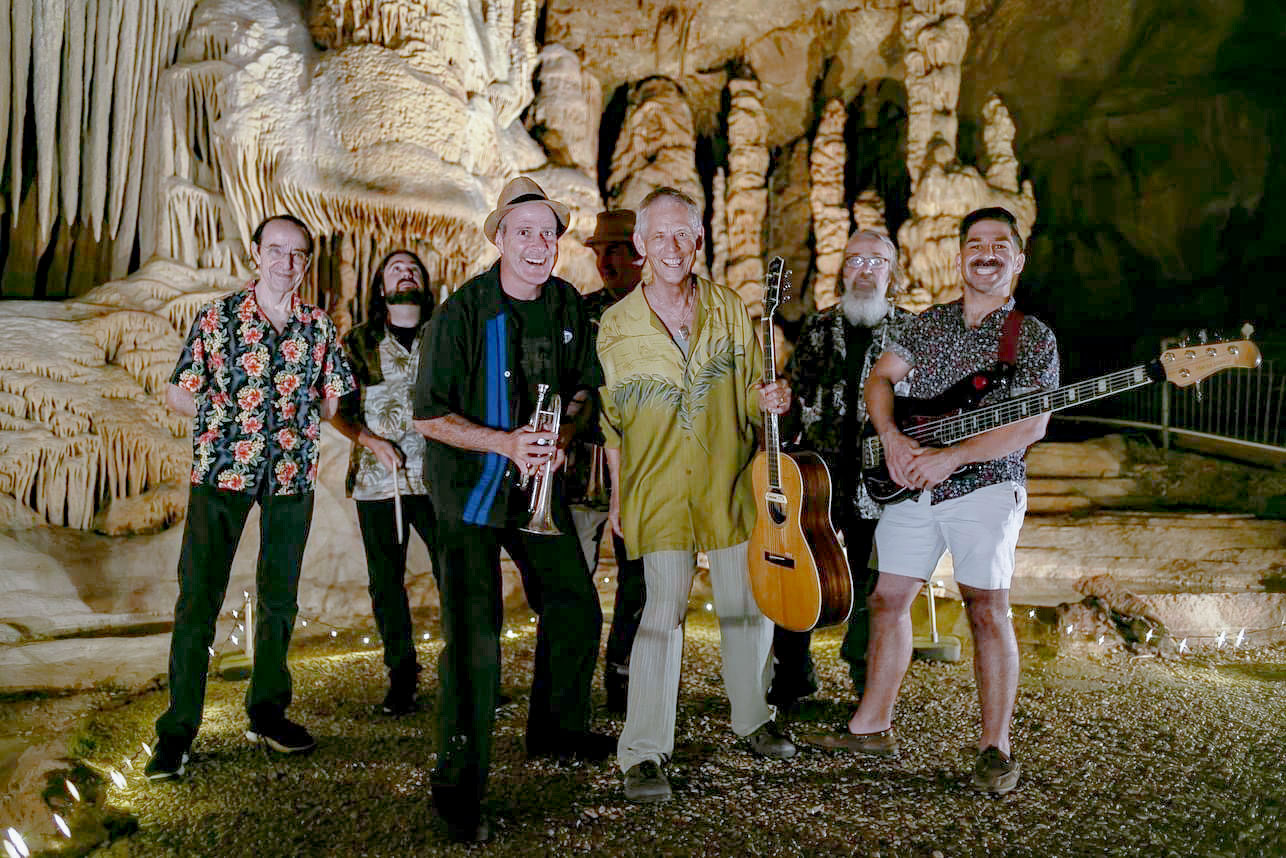
With more than 2.7 miles of mapped caverns on the 167-acre ranch, the show cave (the part of the property open to the public) consists of six main rooms, each rich with stalactites, stalagmites, flowstones, striking soda straws (thin crystalline tubes that form on cave ceilings), and massive, melted waxlike formations. Then, there’s the Queen’s Throne Room. This large, domed space acts like a natural auditorium and plays host to concerts year-round, bringing together up to 200 attendees at once to experience a live show unlike any other.

Harst was one of the first musicians to ever perform inside the cave. In 1981, it was for a private event; almost two decades later, when he and his band, Rudi and the Rudiments, were looking to put on a concert to celebrate the winter solstice, he raised the idea to Tom Summers, who took over ownership of the property in 1998. They performed their first official show for the public in 2002. Since then, Rudi and the Rudiments have performed there every year apart from 2020, celebrating the winter and summer solstice, along with regular concerts throughout the year.
“The acoustics are magnificent,” says Harst, whose next gig will be June 20. “The backdrop is breathtaking, and as a guitarist, the joy of that natural reverberation combined with the magic of making music is so wonderful.”
The performances aren’t without their challenges, though. With its natural formations and grooves, the cave has its own unique acoustic landscape. Sounds bounce and ricochet off the walls in unexpected and exciting ways. There’s also the humidity. High moisture causes acoustic and woodwind instruments to skew sharp, and brass instruments to play flat.
To combat this, Harst and other musicians have to head down early, usually an hour before a show, to let their instruments adjust to the environment, where they’re tuned and re-tuned until they can be brought up to pitch.
For folks afraid of the dark, be warned: Harst likes to perform at least some of his sets in total darkness, opting to turn off some of the venue’s built-in lighting. It makes it impossible for the musicians to rely on visual cues, but it’s a sacrifice that Harst says allows them to connect with the audience, and feel what they’re feeling. The result is a full-on sensory explosion.
“We’re just like them, on the edge of our seats, experiencing the show in surround sound,” he says.
For an hour and a half, the band and the audience are hidden from the rest of the world. Inside the earth, their senses are heightened, magnified by their isolation in the confines of the cave. With the lights off, their hearing grows sharper, and a primordial kind of peace washes over them as the sounds of strings, horns, and drums fill the Queen’s Throne Room. To hear Harst describe it, it’s spiritual.
“It helps us get in touch with ourselves and with the earth,” he says. “Since time out of mind, humans have been marking the solstice and the equinox. It’s a time to celebrate faith in the face of darkness, and I think there’s no better way to do that than with music.” Harst taps into that feeling with his song, “Down, Down, Down,” a boisterous, polka-infused diddy where he sings, “The vibes are all so sweet there, when music fills the air … Down in the Cave Without a Name.”
When he’s performing, Harst invites everyone else to join in, too. Their voices glance off of the walls, becoming something new as they blend together. This, Harst says, is the power of music.
“People who don’t even think of themselves as singers will come up afterward and tell me how amazing it was to sing in the cave,” he says. “It’s such an empowering experience that I just feel lucky to have been able to share with the thousands of people who have come through here for the last 20 years.”