
The crowd under the big top grew quiet as 15-year-old Evelyn Kaps climbed the ladder to a high platform beneath a tightwire. The Gainesville Community Circus was playing to a sold-out crowd of 2,500, and all eyes were on Kaps as she began a daring act called the “Slide for Life.” Standing 30 feet above the audience’s upturned faces, she grabbed a 4-inch strip of leather suspended from the wire, brought it to her mouth, and closed her teeth around the custom-fitted mold at the end of the strip. Then, her head tilted back and her jaw tight, she leaned forward, stretched her arms out gracefully, and coasted along the steel cable above the gasping audience. When she reached the end, she removed the mouthpiece to smile at the astonished crowd as the spangles on her homemade costume glittered in the spotlight.
Between April and September 1949, Kaps executed the stunt before speechless onlookers at 29 performances in cities across Texas and Oklahoma. Since she was 4 years old, she’d been part of the annual spectacle that involved more than 100 fellow citizens of Gainesville, 70 miles north of Dallas. Originally conceived as a local variety show, the circus performed in venues as large as Kyle Field in College Station and Will Rogers Coliseum in Fort Worth during its roughly 30-year run. Locals practiced all year, but no one was paid. Instead, says Susan Walker, Kaps’ daughter, “They did it for the sense of accomplishing something that no small town had ever done before.”
The circus began as a fundraiser for Gainesville’s Little Theatre, which in the late 1920s was struggling to compete with the movies. The troupe held a $300 debt, the equivalent of roughly $5,600 today. Company member A. Morton Smith, the local newspaper editor and a lifelong circus fan, had an idea: Why not put on a circus featuring community members? Townspeople volunteered to show off their tumbling skills and trick-performing dogs, and in May 1930 the circus debuted at the county’s indoor rodeo arena. The event sold out, and organizers added two more performances, drawing a total of nearly a thousand spectators. The theater cleared the debt and netted more than $400, which the group decided to invest in future shows, according to Walker.

In 1931 the circus performed for two professional conventions meeting in Gainesville, and officials from nearby Denton were so impressed that they invited the group to their city. Word spread, and by 1933 the Gainesville Community Circus had a 16-show season. That year, the circus incorporated as a nonprofit that earned money on ticket sales but sank proceeds back into the operation, buying tents and helping cover performers’ travel costs.
The cast took inspiration from major circuses such as Ringling Bros., which stopped in Gainesville and other area communities as it traveled the country via rail. Smaller acts visited the city, too; in the early 20th century there were nearly 100 circuses touring the country, says Janet Davis, a professor of American Studies at the University of Texas at Austin and author of The Circus Age: Culture and Society Under the American Big Top. It wasn’t uncommon for people to try to teach themselves tricks they’d seen professionals perform, she says. After watching a tightwire walker, kids might go home and string a wire between two trees. “That kind of self-taught ethos is very strong in the American circus,” she says.
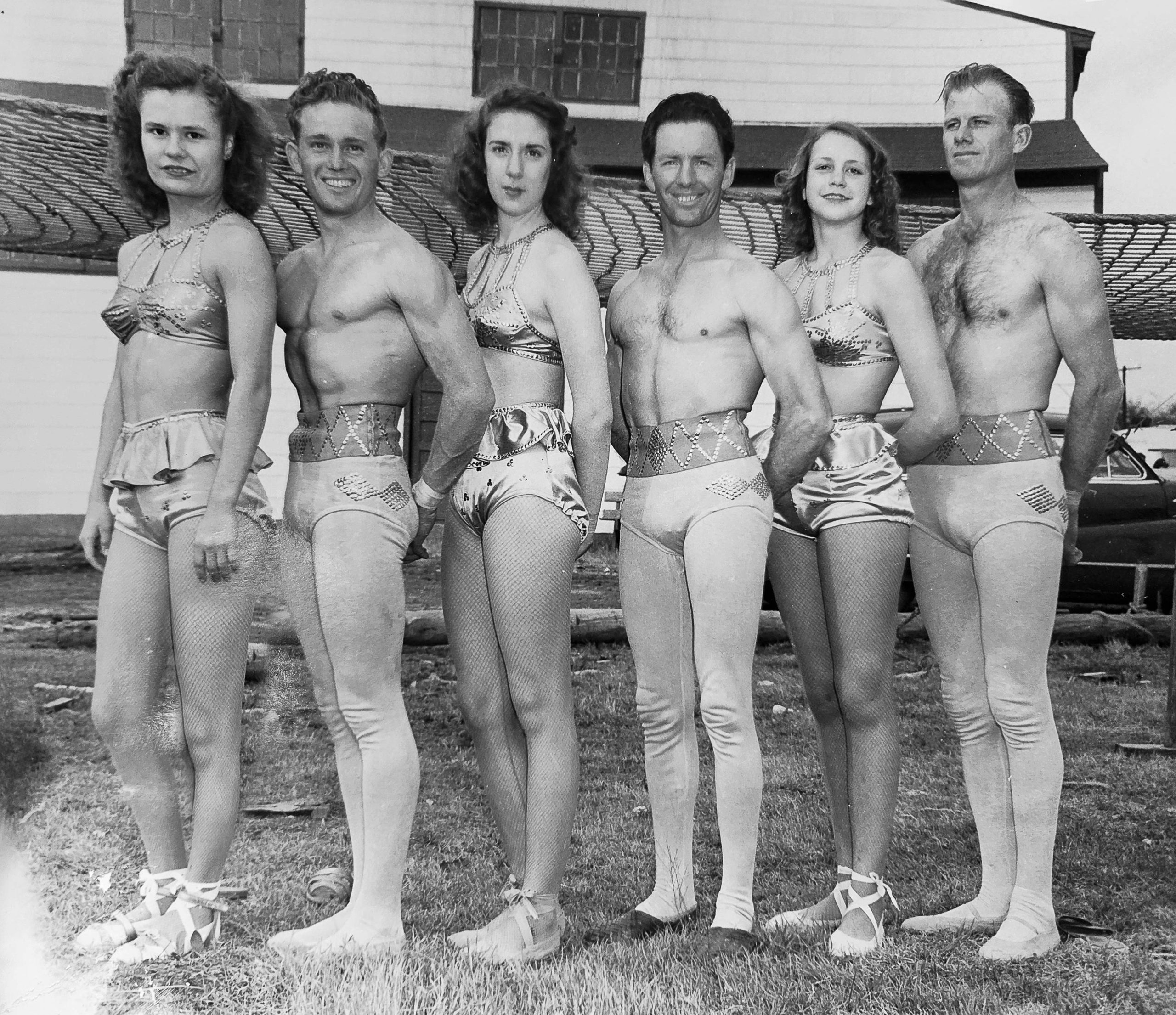
Gainesville had an advantage because some smaller acts spent winters camped in trailers at the county fairgrounds, where they would set up rigging to practice aerial acts. Performers would teach curious locals how to do flips on a trampoline or hang by their teeth from a high wire. In 1947, a woman named Betty Romo coached Gainesville residents on the flying trapeze. Romo grew up in Southern California and spent time at Santa Monica’s Muscle Beach, where fitness enthusiasts practiced acrobatics and aerial stunts. She joined the Peaches Sky Review, an all-female “high act,” where she performed handstands on a 90-foot-tall apparatus, and later became part of the Ward-Bell Flyers, a trapeze company that wintered in North Texas. Romo had been married to one of the troupe leaders, but the two split up when the Flyers left Gainesville, and Romo, who had grown to love the community, stayed and joined the local circus. “She always bragged that she came to town as a professional but ended up an amateur,” says Stephanie Davis, Romo’s granddaughter.
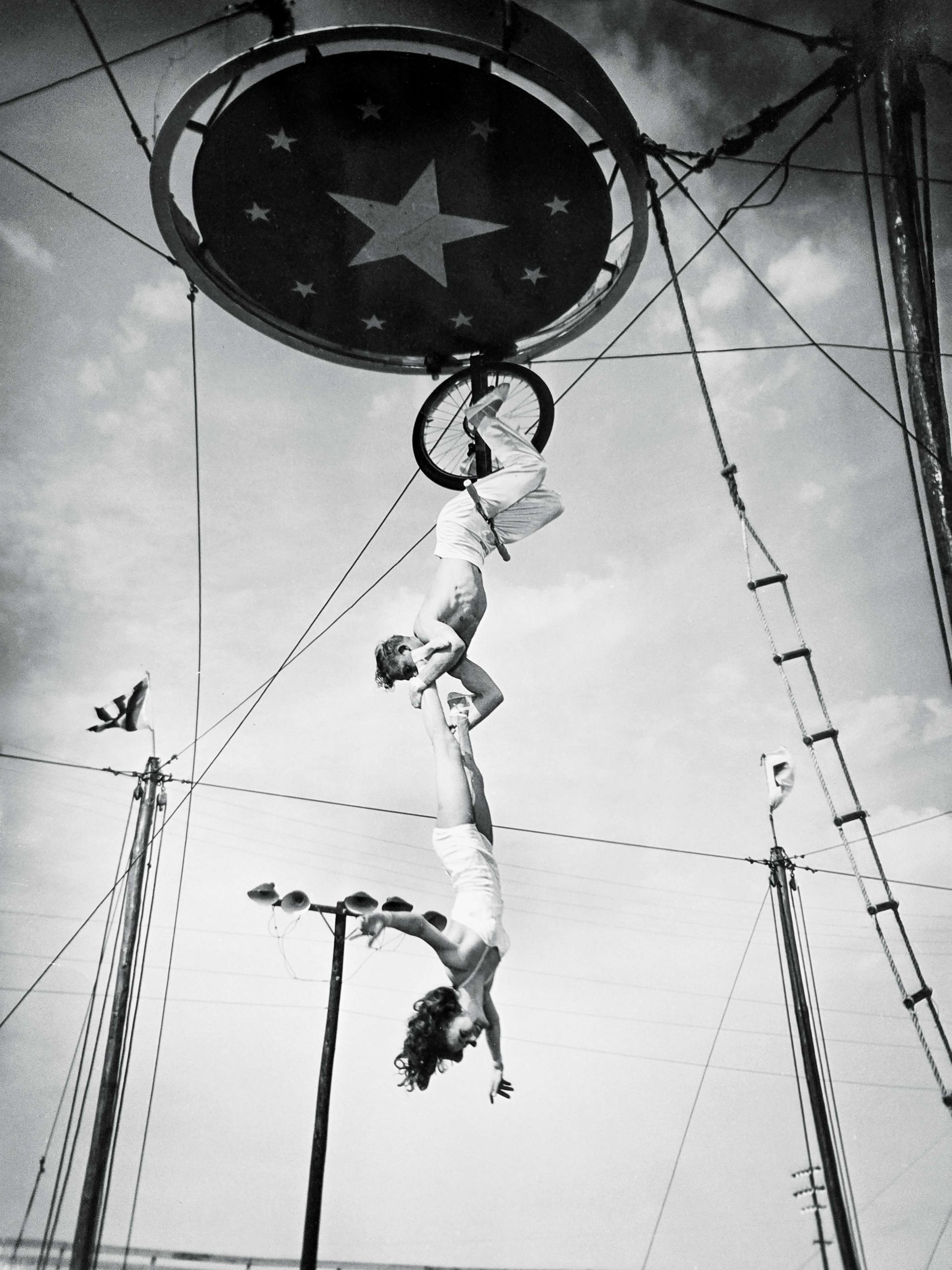
Everyone else had an ordinary day job. One ringmaster managed the local ice factory, and another was an ophthalmologist. A man who owned a dry cleaning business walked the tightwire. The clowns included a high school math teacher and a general practitioner. Kaps performed a flying trapeze act with Ralph Gerneth, who worked at a poultry farm. Gerneth also performed on an apparatus he designed and helped build, an upside-down unicycle with the wheel anchored into an elevated circular track. Gerneth, whose legs were held in place by a bar across his thighs, pedaled around while holding a female performer by the wrists—an incredible feat of abdominal and upper-body strength. He used those skills later in life, his daughter, Lynette Pettigrew, says, when he and a former circus colleague climbed the dome of the county courthouse to add lights in hard-to-reach places. “They were both electricians, but because of their aerial experiences, they could get up there and do it,” she says.
Vern Brewer, a local horse trainer, taught dogs—and children including Kaps—to ride Shetland ponies. He also mastered walking the tightwire. Brewer and Romo eventually married, and Brewer adopted Romo’s two young children. Her son, Dennis Brewer, began performing when he was about 5. When a tiny car drove into the ring and clowns piled out, Dennis was squeezed under the dashboard. “The rest of the clowns stacked like cordwood because there weren’t any seats,” says Dennis, now 80. “I remember one of the adult clowns saying to another, ‘We got 25 in there tonight.’”
The circus went on hiatus during World War II while cast members served in the military. It resumed in 1946 and performed until a fire in late 1954 destroyed the barn that housed the tent and equipment. Although shows were held intermittently for the next decade, the organization was never the same after the disaster, Walker says. By the 1960s, television had supplanted the circus’ role in popular culture and family entertainment. The Gainesville Community Circus had begun because the local theater was threatened by the big screen; it ended partly because of competition from the small one.
Cast members gathered for reunions in the ’70s and ’80s; today, most have passed on. Until she died three years ago at 102, Betty Romo Brewer loved to tell anyone who would listen about her days in the local circus, Davis says: “It was her favorite time of her life.”