
Gary E. McKee explains Texas polka in the simplest of terms: “Polka is happy music for happy people.” He should know. The 72-year-old lifelong resident of Fayette County is editor, main writer, and chief photographer at Texas Polka News. The monthly publication and website are underwritten by the Texas Czech Heritage and Cultural Center in La Grange, which is where I meet McKee.
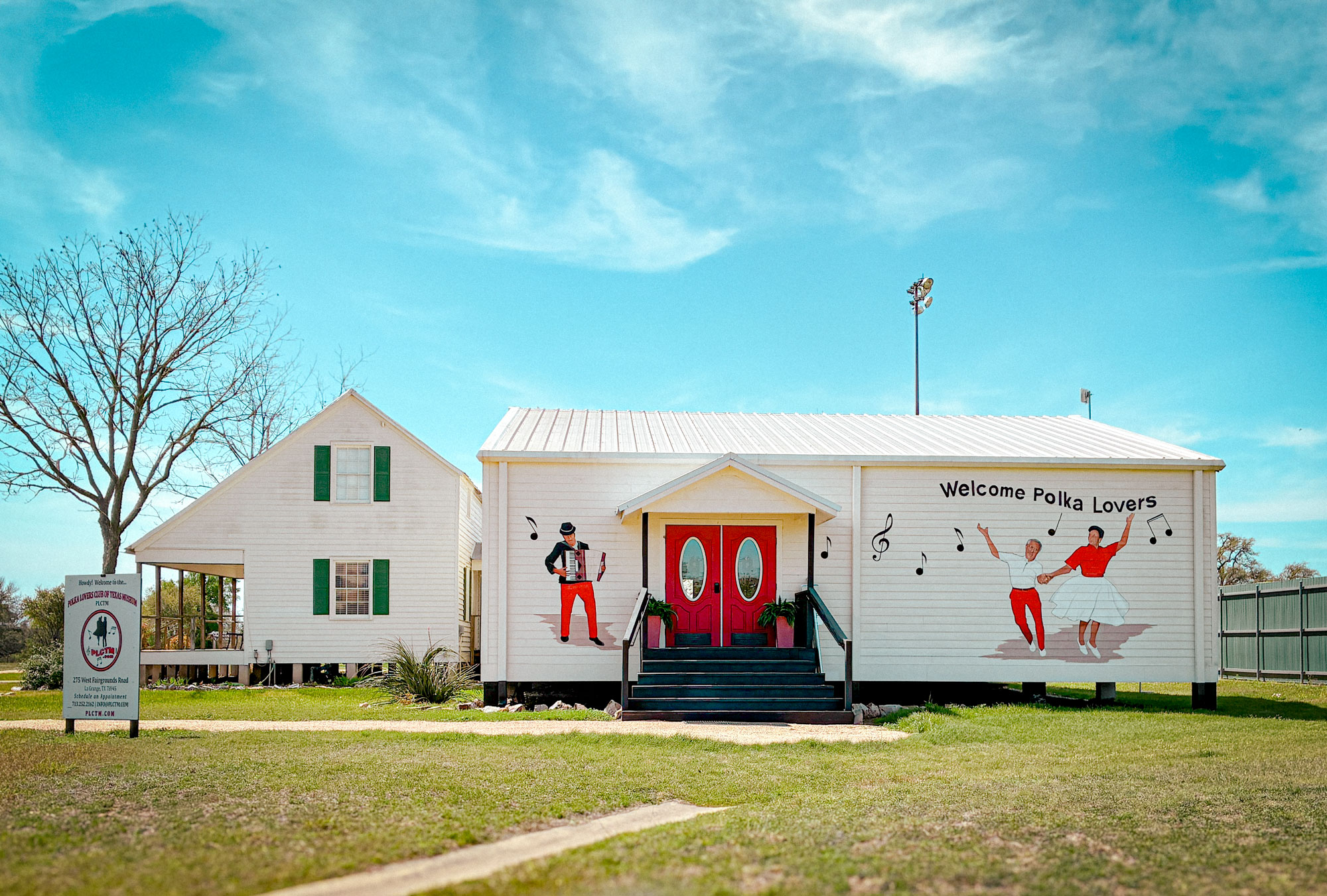
Actually, I find him behind the center, north of town, next to two white clapboard buildings. The message “Welcome Polka Lovers” is painted atop the front of one side of the building, above the likenesses of a man playing accordion and two dancers dressed in red and white. On another side of the building are paintings of an accordion player and two saxophonists flanking another dancing couple wearing red and white. Floating music notes dot each mural.
Texas Czech Heritage and Cultural Center
250 W. Fair Grounds Road, La Grange. 888-785-4500, czechtexas.org
“This is the Polka Lovers Club of Texas Museum,” McKee says, introducing me to Gary Bucek and Carol Artz-Bucek, both dressed in red. The Buceks are stewards of 1,500 square feet of accordions, saxophones, posters, photographs, and other artifacts of Texas polka history, including the ornate 19th century bar from Frank’s Place Bar.

The adjacent Hoelscher Haus, moved from nearby Ellinger, archives awards and ribbons from members of the Texas chapter of Polka Lovers Club of America, along with the Hoelscher family history. If you’ve ever been to a polka dance, Polka Lovers Club members comprise the hardcore group dressed in coordinated red and white outfits, and sometimes in traditional vests and dresses.
The PLCT museum opened in 2006 as part of the Texas Czech Heritage Center and has attracted busloads of folks from Houston using polka as exercise. “We’re dancing with Asians, Baptists, people from Austin,” Bucek says. “We have a busload coming from Minnesota.”
McKee, both Buceks say, is always on the scene. “We see him at every dance we go to,” Artz-Bucek says.
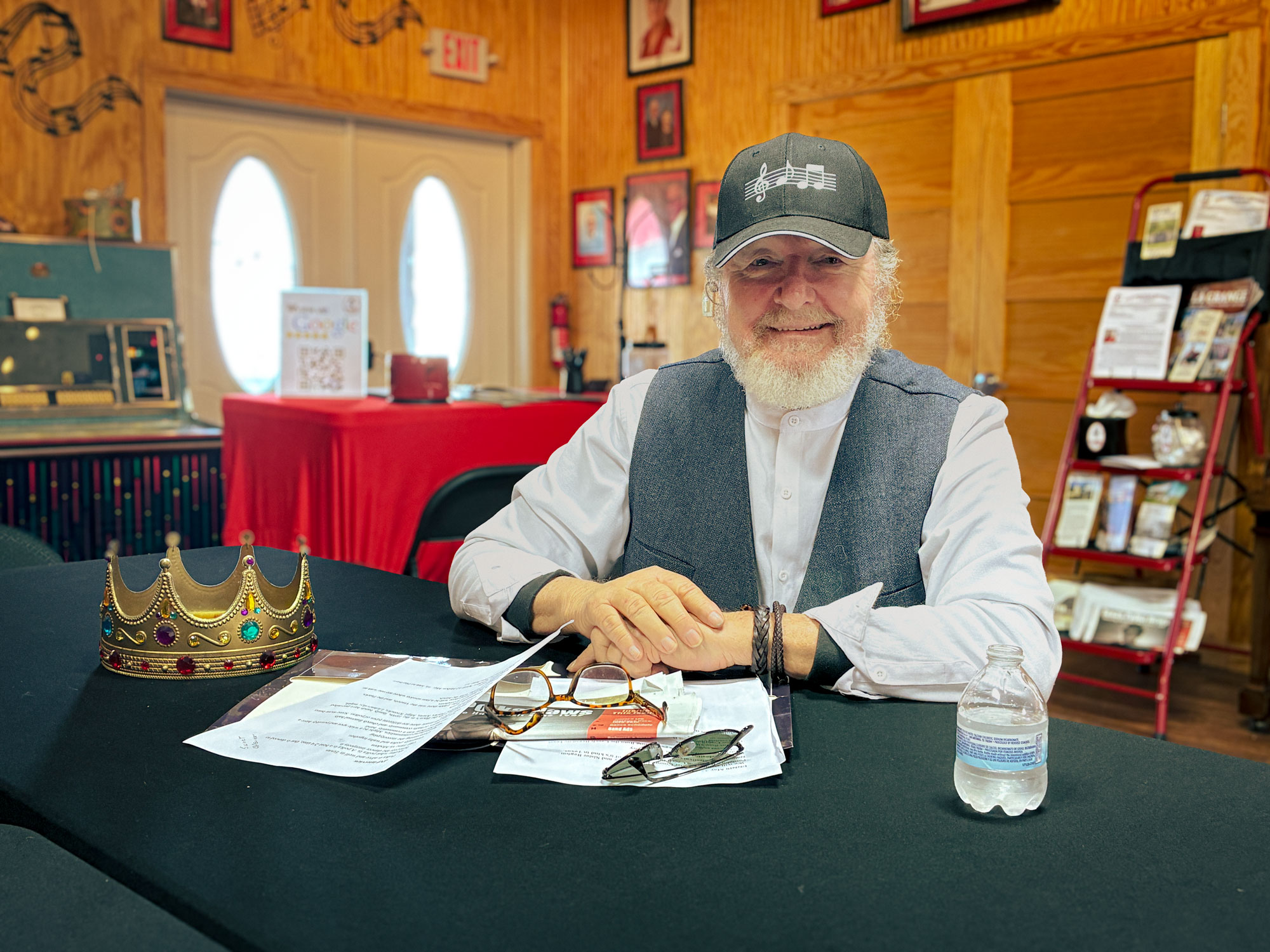
Yet McKee came to polka late in life. “I grew up dancing at the Swiss Alp,” he says, of the storied dance hall between Schulenburg and La Grange. His jam then, as a teenager in Schulenburg, was rock and roll, country, and soul played by the Triumphs, the Traits, and other bands on the regional teen dance hall circuit.
“I didn’t dance polkas, except at local church picnics,” he says, referring to the annual celebrations that remain the social event of the year in many small rural Czech communities.
After retiring from a job calibrating lab equipment that kept him on the road, McKee realized, “There was nowhere to dance.” But when he attended the annual church picnic in Ammannsville to visit with old friends from school, he rediscovered the sound that had been around him his entire life. Polka gave him the chance to dance again.
He plunged in by writing, photographing, interviewing, researching, history, and beginning his association with Texas Polka News in 2012.
He’s since built a database of locally advertised polka gigs in Texas dating back more than 120 years while expanding the modern polka purview to include dance halls that don’t necessarily feature traditional polka. He has also profiled modernists like Alex Meixner as well as legends such as Alfred Vrazel, the Baca family (“Since 1892 there has been a Baca on stage in the Fayette County area“) and Shiner’s Joe Patek. He recently wrote a history of the Shiner Hobo Band that dates back to the 1890s.
Now, he’s Texas polka’s chief networker. He puts 40,000 miles on his Chevy Trax every year attending polka events around the center of the state, taking photographs, reporting stories, writing historical and contemporary articles, and selling ads.
Everything happens within what he describes as the Polka Diamond. “Start in Houston, go up I-45, stop in Ennis, cut across Texas 34 to I-35 and south to West, then south on I-35 through the Temple area to the New Braunfels area, then east over toward Lavaca County, over to Richmond/Rosenberg, back up to Lodge 88 in Houston. Everything inside that is polka territory.”
So what exactly is Texas polka?
“Polka is a step and the 2/4 beat with emphasis on the two and the four,” McKee explains. Lyrics are sung in Czech (or German or Polish) as often as English. The dance is a modified two-step involving a pronounced heel click. Polka is Czech culture as much as it is a kind of music, just as polka dances are more than just polka.
During a typical live set, a polka is followed by a waltz, then a country two-step or a participatory novelty number, such as the “Chicken Dance” or a line dance like “Cotton-Eyed Joe.” McKee says he even heard “Sweet Caroline” twice the weekend before in Hallettsville.
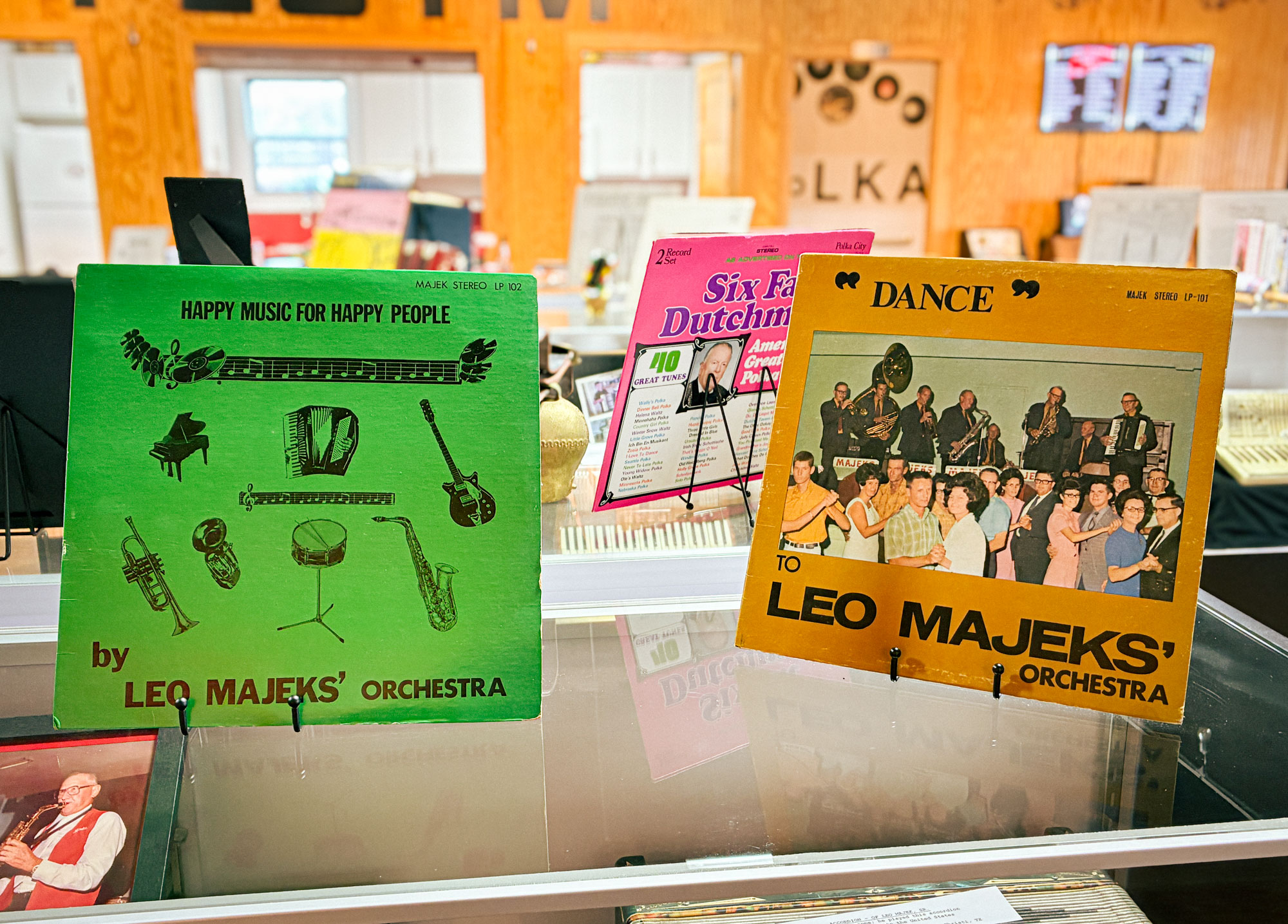
The music was introduced to Texas in the late 19th and early 20th century by German, Polish, and Czech immigrants. Tex-Czech polka dominates Texas polka today, although a few German and Polish pockets remain. Compared to polka in northern states, Tex-Czech polka is peppier, the beats snappier, the accompanying brass instruments louder and more assertive.
In the early 20th century, Mexican immigrants in Texas heard these European styles of polka, and appropriated the polka, adding their own twist. Tex-Mex accordion legend Flaco Jimenez and his brother Santiago, Jr. both told McKee about going to hear the German oompah bands with their father, Santiago, Sr. Polka remains the foundational sound of conjunto music in South Texas, where it’s described as musica alegre, or, “happy music.”
McKee worries about future generations of polkaholics; the youngsters aren’t urged to play. And he frets about the general public’s perception of polka as a bloated, uncool oompah sound, thanks to parodies of guys in lederhosen, The Lawrence Welk Show, and John Candy’s character as a midwestern polka musician in Home Alone character and his work on SCTV as part of the polka duo the Schmenge Brothers.
“Kids saw polka as stupid and silly,” he says. “It’s an easy laugh because people don’t understand it.” But McKee hears beautiful music.
Swing dancers have been showing up for the monthly polka dance at SPJST Lodge 88 in Houston, and a good number of kids “from not around here,” he says, showed up for the new second Sunday polka dance at the Fayetteville Community Center.
Some three dozen bands work the Texas polka circuit. He’s particularly high on the Red Ravens, founded 70 years ago, and the Ennis Czech Boys. “They’re too old to be young,” he says. “But they’re playing all sorts of off-the-wall pop.”
McKee cited Mark Halata and Chris Rybak for carrying on the traditional sound, and Denton’s Brave Combo for their offbeat style, originally described as “Nuclear Polka,” for working rock venues as well as developing into a regular featured attraction at Westfest.
Alex Meixner, the accordion star of Wurstfest, played the event so often that he moved from Allentown, Pennsylvania, to New Braunfels. “Where else can a guy in lederhosen playing the accordion be treated like a rock star?” he says. Meixner is a third-generation Austrian accordionist who plays all the variations of polkas as well as other styles. He tours nationally while tapping into the Texas polka festival circuit.
“When he moved here, he told me he wanted to get out in the communities around here where the polka was a tradition and put on shows,” McKee says. Meixner also does presentations for schoolchildren.
Festivals complement the church picnic circuit, attracting larger crowds, celebrating kolaches, sausage, zimne piwo (cold beer) and whatever else is worth celebrating. Slavnost, in La Grange at the Texas Czech Heritage Center by the Fairgrounds, has become a classic with its Maypole dance, Czech-centric focus, and polka. The 29th edition is May 17. The big daddy is the National Polka Festival, held this year from May 22-24 in Ennis, which draws over 50,000 fans.
“Ennis is Polka Mecca that weekend,” McKee says. “They must have poured beer into the water system. There are six polka bands in a town of 20,000.”
Mobility issues keep McKee off the dancefloor these days. But polka keeps him going. Working with several volunteer photographers, they cover as many as six dances, picnics, and festivals on a weekend. The images show people, mostly dancing, some in traditional Czech garb. Everybody’s smiling.
“You look on our site and see where everybody was [last weekend],” McKee says. “At the country and Western dances, nobody’s smiling. The men look like they’ve been dragged there by their wives. If they aren’t smiling, they get deleted.”