

From the small parking lot, the blue, concrete-brick bar doesn’t look like much. The only hints about what awaits inside are the spray-painted clown’s mouth surrounding the front entrance and the clown-shaped bar sign that lords over Route 66.
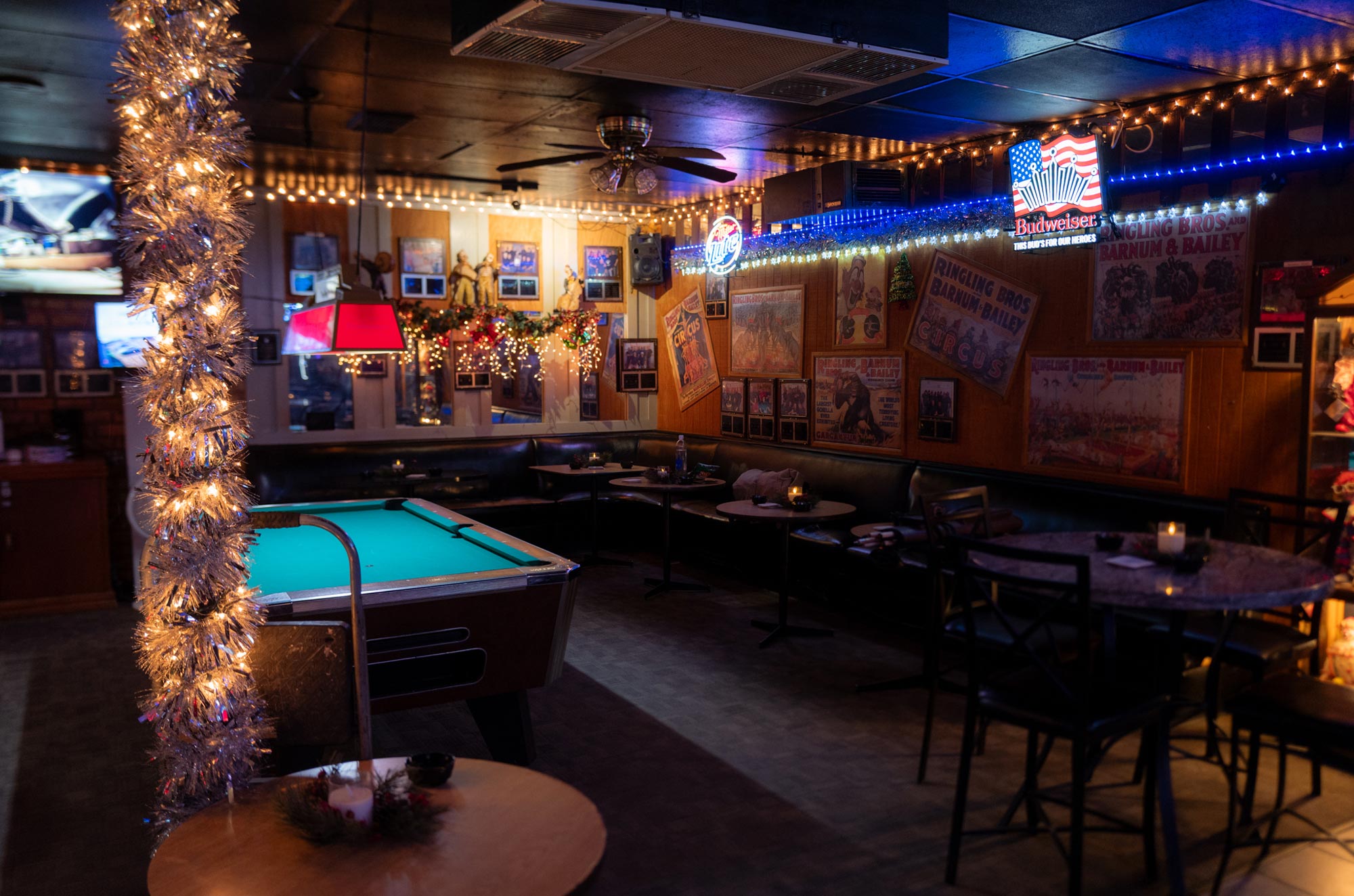
Stepping inside Circus Room is like entering a different era. Vintage Ringling Brothers posters and clown décor cover the walls, and a lit display case housing a collection of retro clown figurines, smiling their little clown smiles, stands by the front door. An enclave behind the bar holds even more clowns. And when I visit the Amarillo lounge on a cold, mid-December night, even the bartender plays along with the theme, emerging from behind the bar to perform a circus trick of her own: two nearly perfect cartwheels.
Opened in 1962, the Circus Room is a monument to classic Texas dives. According to Visit Amarillo, the Amarillo Convention and Visitors Bureau’s website, it is the oldest continuous bar on all of Route 66. Still circus-themed after all these years, its etymological origin remains anyone’s guess.

Wes Reeves—who, as a board member of the Amarillo Historical Preservation Foundation and former Amarillo Globe-News reporter, may be the closest person Amarillo has to a town historian—isn’t sure why the old bar off Route 66 is called Circus Room. When I meet him at the Amarillo Chamber of Commerce, a historical home turned municipal building near the center of town, the best guess we come up with is that original owners, Jack Ware Kaboth and Bruce Dale Andrews, drew inspiration from all the times the circus stopped in Amarillo throughout the 1950s and ’60s.
Reeves shows me a copy of a newspaper clip, dated Jan. 12, 1962, announcing a new bar at 2309 W. 6th Street. Back then, Route 66, which turns 100 this year, was the main thoroughfare through town. Construction of Interstate 40 would begin in 1963, so it’s probable that Circus Room was a popular spot along the famed highway before the new interstate opened.
Reeves walks me through a possible past life for the little bar just northwest of the center of town. Once a tiny town, post-World War II Amarillo experienced a boom. An Army Air Force Base reopened east of town in 1951, Reeves explains, and by the time Circus Room came into existence, Amarillo’s population was expected to swell to more than 300,000. (The city’s current population is just over 200,000.)
“A lot of these nightclubs that were built in the ’50s and ’60s probably catered to the air base and the growing population in general,” Reeves says. He imagines Circus Room as a spot for men at the base and on leave, reveling in the big top décor as a respite from their staid military lives.
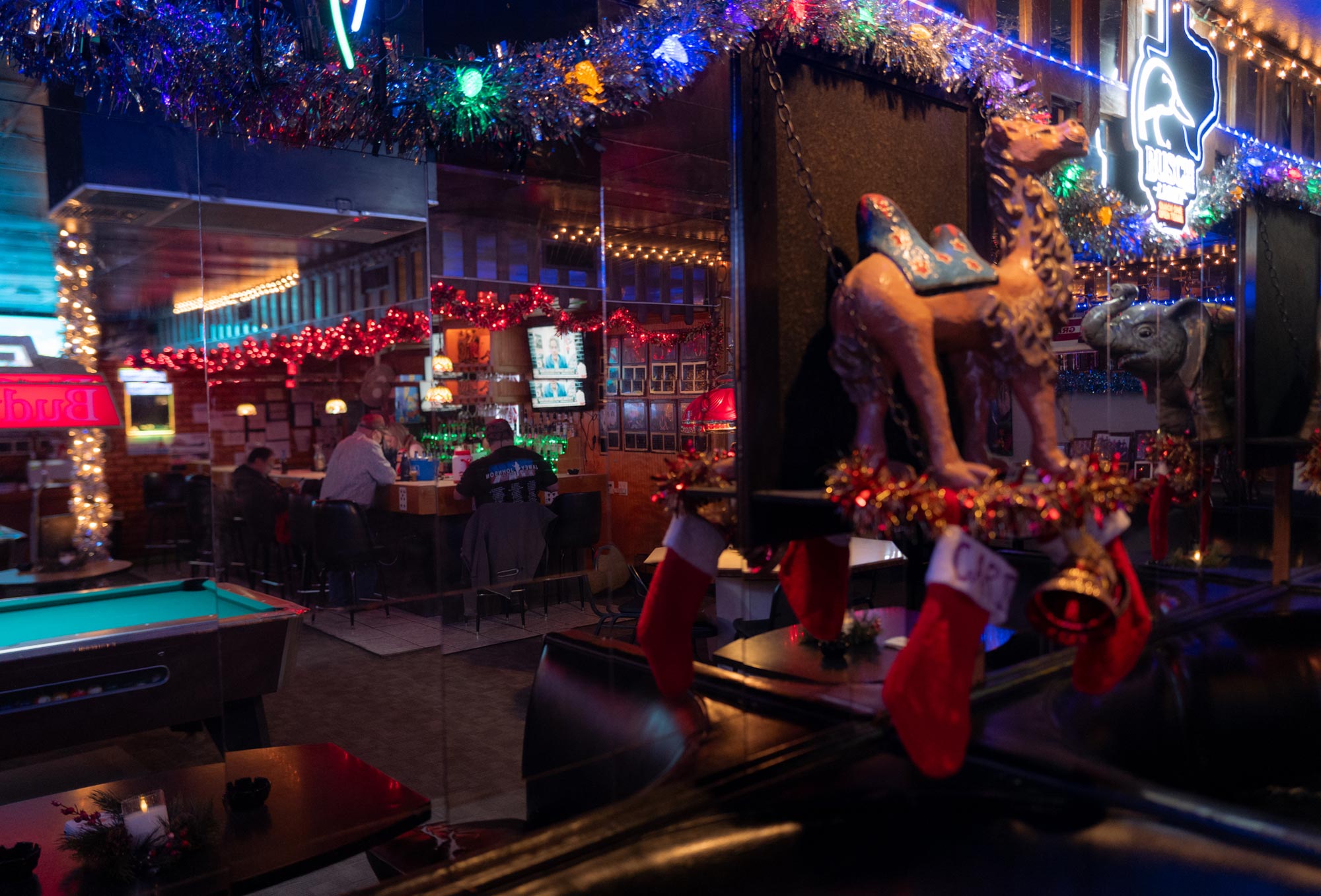
In 1964, the base closed, thwarting Amarillo’s great boom. As hundreds of residents left town and movement to Amarillo slowed, Circus Room persisted. And it somehow survived through the ’60s and ’70s as I-40 paved a faster alternative to the meandering pace of Route 66. While several businesses migrated away from Route 66 since the interstate opened, Circus Room has stood its small plot of ground.
These days, the Circus Room is a certified dive, beloved by a cabal of regulars and visitors to town alike. The bar, owned by Joyce Kosechata, opens daily at noon and serves beer, wine, and mixed drinks until 2 a.m.—that is, unless supplies run out, which happens the night I go. The same bartender who performed cartwheels for me is tasked with letting us know that they’d run out of Miller High Life.
Ashtrays sit waiting on indoor tables—Circus Room doesn’t have a patio—and the scent of decades of cigarette smoke clings to the walls. (Several prior attempts to ban cigarettes indoors have been unsuccessful.) The most noticeable sign of contemporary times is a digital jukebox, being used solely by a man sitting at a tall table in the back corner of the bar who plays a mix of classic and contemporary country songs. Another man hawks raw rib-eye steaks to patrons from a cooler. Everyone seated at the wooden bar seems to know each other. When I walk in, someone—I can’t tell who—yells, “You traveling? We can tell.”
Graci D’Amore, another visitor, holds Circus Room in high esteem. She tells me her infatuation began when she frequently traveled from Austin to Amarillo for work. She asked a local for a recommendation for “the divey-est bar in town,” and someone pointed her toward a colorful building with a clown’s mouth for a door. She has stopped by Circus Room on every trip since.
“It became this ritual,” D’Amore says. “It’s so beautiful. I love it. I just want to drink and play pool and listen to country on the jukebox and smoke cigarettes inside.”
Like me, D’Amore is an outsider relative to the typical patrons of Circus Room. She’s in the process of slowly leaving Texas to make a home in Amsterdam. Like many who have left this state, she longs for its relics when she’s away. She’s found one in an inexplicably circus-themed bar off Route 66.
“It has this old Texas vibe that I just love,” D’Amore says. “It’s this little piece of old Texas that’s still there.”