

Revolutionaries gathered In the green rolling hills around the sparsely populated town of Washington on March 2, 1836. There, Gen. Sam Houston, revolutionary Andrew Briscoe, and author Lorenzo de Zavala, among others, signed the Texas Declaration of Independence, formalizing their rebellion against the Mexican government. At the same time, relatives and friends were at the Battle of the Alamo, dying at the mission as the congress deliberated. The delegates’ decision led first to the short-lived Republic of Texas, then to the Republic’s annexation as the 28th state.
Washington-
on-the-Brazos State Historic Site
23400 Park Road 12, Washington.
936-878-2214; thc.texas.gov
Since 1916, the monumental event has been memorialized at Washington-on-the-Brazos State Historic Site, a 300-acre park and museum complex in Washington, 35 miles southeast of Bryan. And on Nov. 8, the park reopened after a $57.4 million renovation that began in fall 2023. The site now includes an updated museum and visitor center and the new Washington Townsite Experience, a replica of the town where Texas first became Texas. The museum’s new approach emphasizes how connected and fast-moving the set pieces of the Texas Revolution really were.

Part of the goal of the renovation is to knit what was happening in Washington more closely to other sites of the Texas Revolution, says Jonathan Failor, director of the site. Historically, places like Washington, the Alamo, and San Felipe de Austin have tended to be siloed. “These sites are not disconnected; they were all connected to each other in the past,” he says. “We need to make concerted efforts to connect ourselves today.”
With one notable exception, many Texans recall very little of Texas revolutionary history, says Stephen Hardin, a historian and the author of Texian Iliad: A Military History of the Texas Revolution. “My students remember the Alamo to the exclusion of everything else,” says Hardin, who taught at McMurry University. “I don’t know that most modern Texans remember Washington at all.”
In 1835, the growing friction between the Mexican federal government and Anglo Texan settlers—over the former’s centralization attempts and outlawing of slavery—burst into an open war. Two months into the conflict, Houston chose Washington as a staging point for revolution. Delegates for the Convention of 1836 gathered there in a wooden meeting hall to plan their next steps. And that March, as increasingly desperate letters arrived from the rebels holed up in the Alamo, the delegates signed the Texas Declaration of Independence, wrote themselves a constitution, and established an interim government. Then, as General Santa Anna’s forces approached, the delegates, and the entire town, fled.
The Washington that had welcomed the congress “was half-built,” says Michael Moore, historian and project manager on the new townsite experience, and Washington after the war was “half-abandoned” due to an economic crash. It only started to rebound in the last two years of the Texas Republic, when Sam Houston, then serving his second term as president, made it the new capital of Texas.
The designation brought with it the Republic’s congress, courts, and foreign embassies to work in spare rooms and buildings. But its glory was fleeting. Anson Jones, the fourth and final president of the Republic, oversaw the annexation of Texas by the U.S. The session of the Texas Congress that voted to join the Union in 1845 did so just 300 feet from where the Republic had first come into being.
Its spot on the river and the cotton trade meant Washington initially thrived after the Republic ended. But economic shifts eventually accomplished what the Mexican army had not. Railroads changed the flow of commerce, causing the riverboat traffic on the Brazos to dwindle. Ultimately, all that was left was a broad field dotted with live oaks, its past concealed beneath the dirt.
Yet the area never lost its historical significance, Failor says. In 1915, the state Legislature funded a park on part of the old townsite, creating Washington-on-the-Brazos State Historic Site. The original Star of the Republic Museum, a star-shaped building holding artifacts and documents from 19th-century Washington, opened on March 1, 1970. “It’s the only museum dedicated to telling the story of that 10-year period that Texas stood as an independent nation,” Failor says.
The park also established the Barrington Living History Farm surrounding Jones’ house, where he retired after his tenure. It was at the living history complex—where history interpreters farm with oxen and carry out the day-to-day business of a 19th-century agricultural operation—that Failor got his start as an interpreter in 2012. By that time, the location of the old Washington was empty of everything but a reconstruction of the building where Texas declared independence.
The importance of the site had long made people hesitate to build on top of it for fear of disturbing the archeological record. But two years of research and excavations helped them pinpoint exact locations of former buildings—and turned up over 200,000 new artifacts, some of which are on exhibit.
Twice per month, professional and volunteer interpreters keep historical trades like carpentry and blacksmithing alive in buildings furnished as accurately to the period as possible. A reconstruction of the one-room cabin that was Sam Houston’s presidential office, for example, brings life to the room where he lay on a couch and dictated the business of the Republic to his secretary. A spare blacksmith shop shows the history of the enslaved Black Texans who often performed such jobs and had long worked on the area’s agricultural plantations.
The visitor center and museum now feature sharply designed exhibits, including an immersive theater weaving together the declaration and the defeat at the Alamo. Painterly murals color the walls behind artifacts like the sword of Mirabeau B. Lamar, the Republic’s second president, and the sole remaining flag of
the Republic.
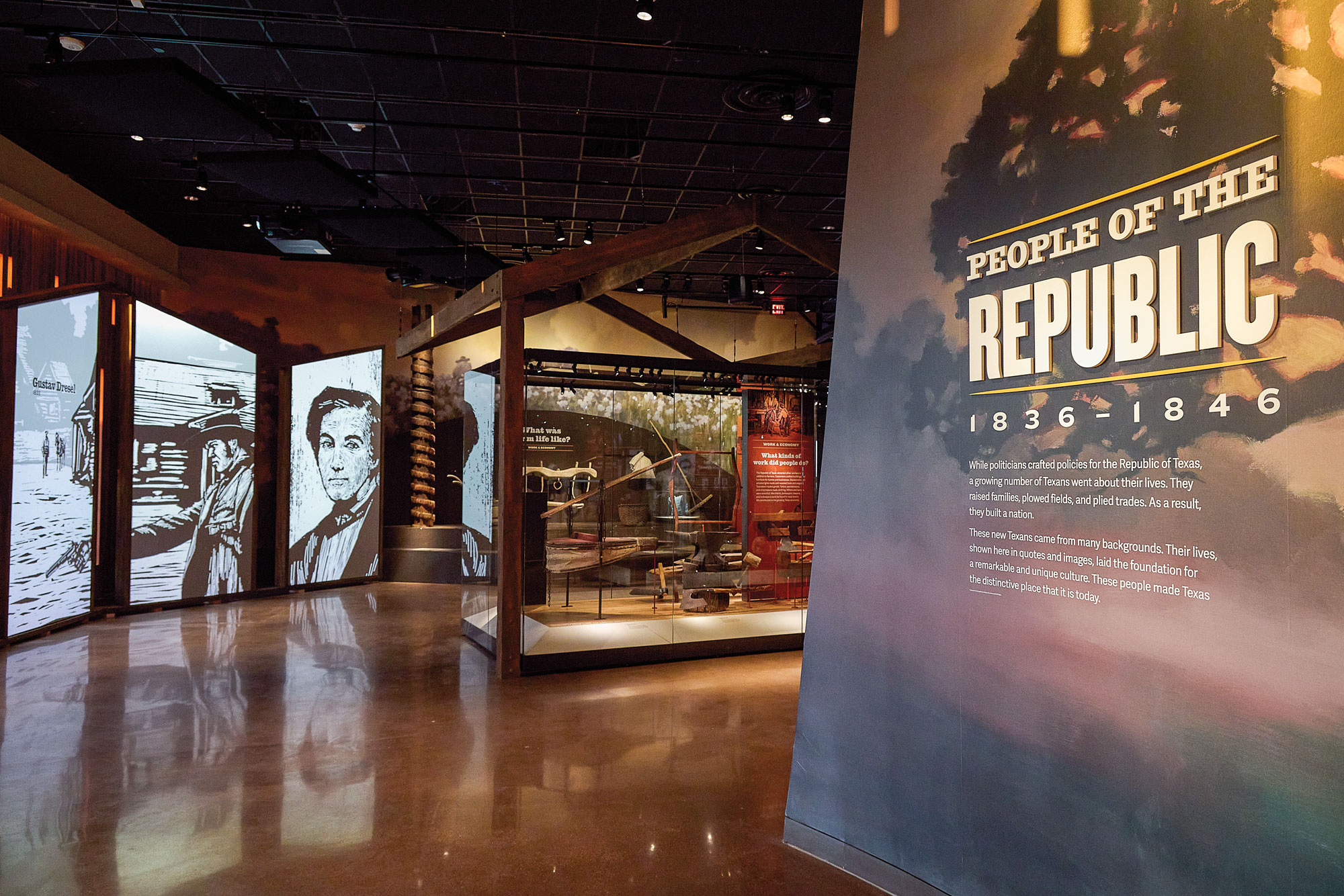
The museum’s bottom floor lays out the political history of Texas’ rebellion, war, and statecraft, while the second floor features a large display about the lives of everyday Texans under the Republic. These men and women made the country—and subsequent state—run. That point is hammered home in the final display: 50 pictures of notable Texans throughout time, from Lyndon B. Johnson to Beyoncé. Failor says the intent is to show how the Republic’s value of grit has proliferated even today. LED screens set into the walls show a rotating panel of honorary mentions, and visitors can take their own photo and add it to the mix.
“These people who arrived in the 19th century came to Texas to find something better, a greater opportunity,” Failor says. “And that’s exactly what Texas presented to my wife and me. It was an opportunity for something new, an opportunity to better yourself.”