
I can’t remember the first Texas movie I ever watched as a kid, but that’s because we didn’t think about “Texas” movies when I was growing up in Plano. It’s possible I saw The Searchers or Red River on KTVT Channel 11 on a Saturday afternoon, but I am certain about one thing: the Sunday evening in May 1983 when Urban Cowboy made its network television debut. Sitting cross-legged on the floor, I came for John Travolta, the music, and the mechanical bull.
Urban Cowboy had premiered in Houston in June 1980, so by the time I saw it in my living room, the entire nation had been enthralled by the country craze for years. My sister drove a GMC pickup with a Mesquite Championship Rodeo bumper sticker, we listened to KSCS country radio, and I received a silver buckle and Western belt with “BRIAN” stamped on the back for a birthday present. Remember, this is Plano in the early ’80s.
Of course, that influence spoke to the wild popularity of the film. It didn’t matter where you lived. Everyone in America knew Urban Cowboy and Gilley’s. And everyone loved Bud and Sissy.
Gloriously self-indulgent and delightfully melodramatic, Urban Cowboy captured a specific moment of Texas culture at a specific location: Gilley’s, the world’s largest, smokiest, sweatiest honky-tonk that could pack in 7,000 concrete cowboys and buckle bunnies on a single night. Located at 4500 Spencer Highway in Pasadena, just outside Houston, Gilley’s may well have been the most famous address in the world at that time. But watching the film more than 45 years after its release, I was struck by two competing thoughts: How could a place like Gilley’s have ever existed? And why can’t Gilley’s still exist today?
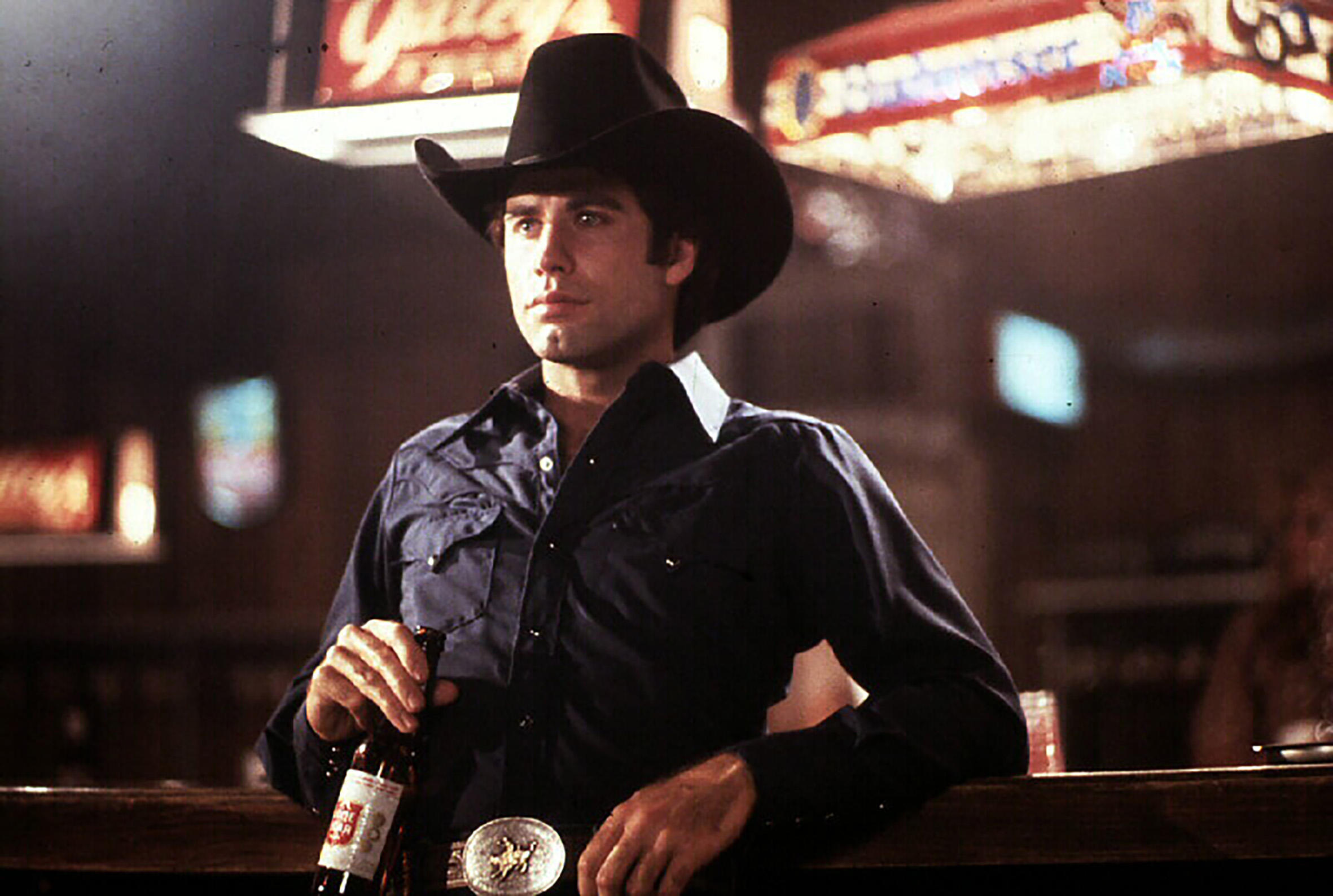
It was the packaging of Urban Cowboy that made it such a sensation. The blockbuster soundtrack with Johnny Lee singing “Lookin’ for Love.” The effortless country dancing, which was choreographed by Houston’s Patsy Swayze, the mother of Patrick. The fistfights and the Dolly Parton look-alike contest. And then there was the star power of John Travolta. Do you remember that shot of him, standing with his back to the bar, looking off to his right as he holds a Lone Star longneck with both his blue eyes and silver buckle gleaming? How could you not? It’s one of the most iconic images in Texas movie history.
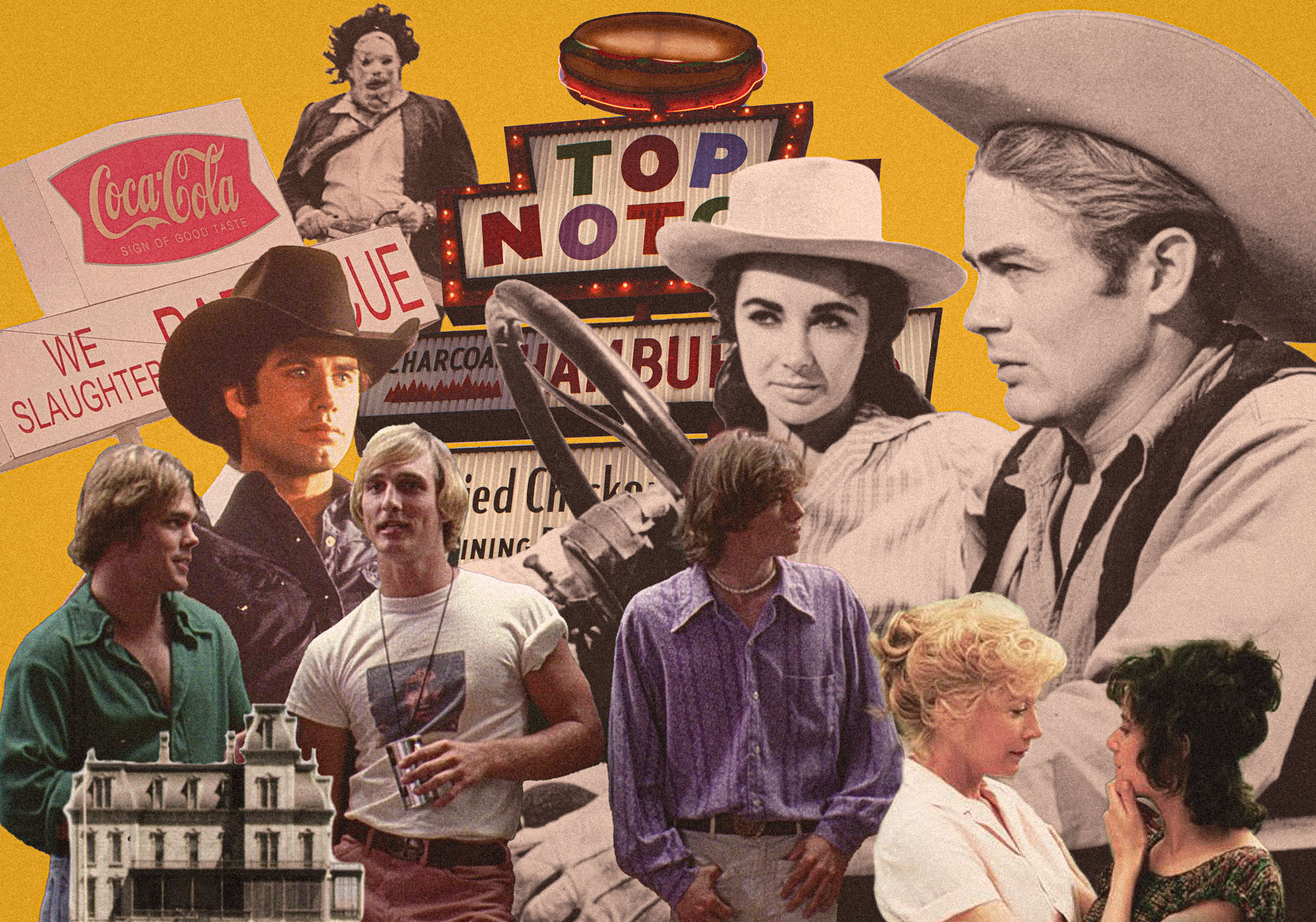
REEL TEXAS
We’re revisiting the classic films that shaped the mythos around the Lone Star State

The film was based on an Esquire cover story by Aaron Latham titled “The Ballad of the Urban Cowboy: America’s Search for True Grit.” Latham, who grew up in Spur, wrote about the turbulent real-life romance of two Gilley’s regulars named Dew Westbrook and Betty Jo Helmer, who inspired the characters of Bud and Sissy.
Translated from the magazine article, Latham turned the plot of Urban Cowboy into, well how to put it? There’s not really a plot.
Sure, there’s action and exposition, but plot was the last thing that made this movie a success. In its simplest terms, Urban Cowboy has three main characters: Bud, played by Travolta; Sissy, played by Debra Winger; and the Mechanical Bull, played by Himself. Bud and Sissy meet one night at Gilley’s and embark on a romance that makes Romeo and Juliet look like The Brady Bunch. They dance, they fall in love, they fight, they wrestle in a flooded ditch just off the highway, and, still soaking wet, they decide to get married when Bud proposes in his pickup. They hold their wedding at Gilley’s, fight some more, make up, then threaten divorce as they each start seeing other people (Bud with high-class Pam, played by Madolyn Smith; Sissy with ex-con Wes, played by Scott Glenn). As far as I can tell, all of this happens in the span of about two weeks.
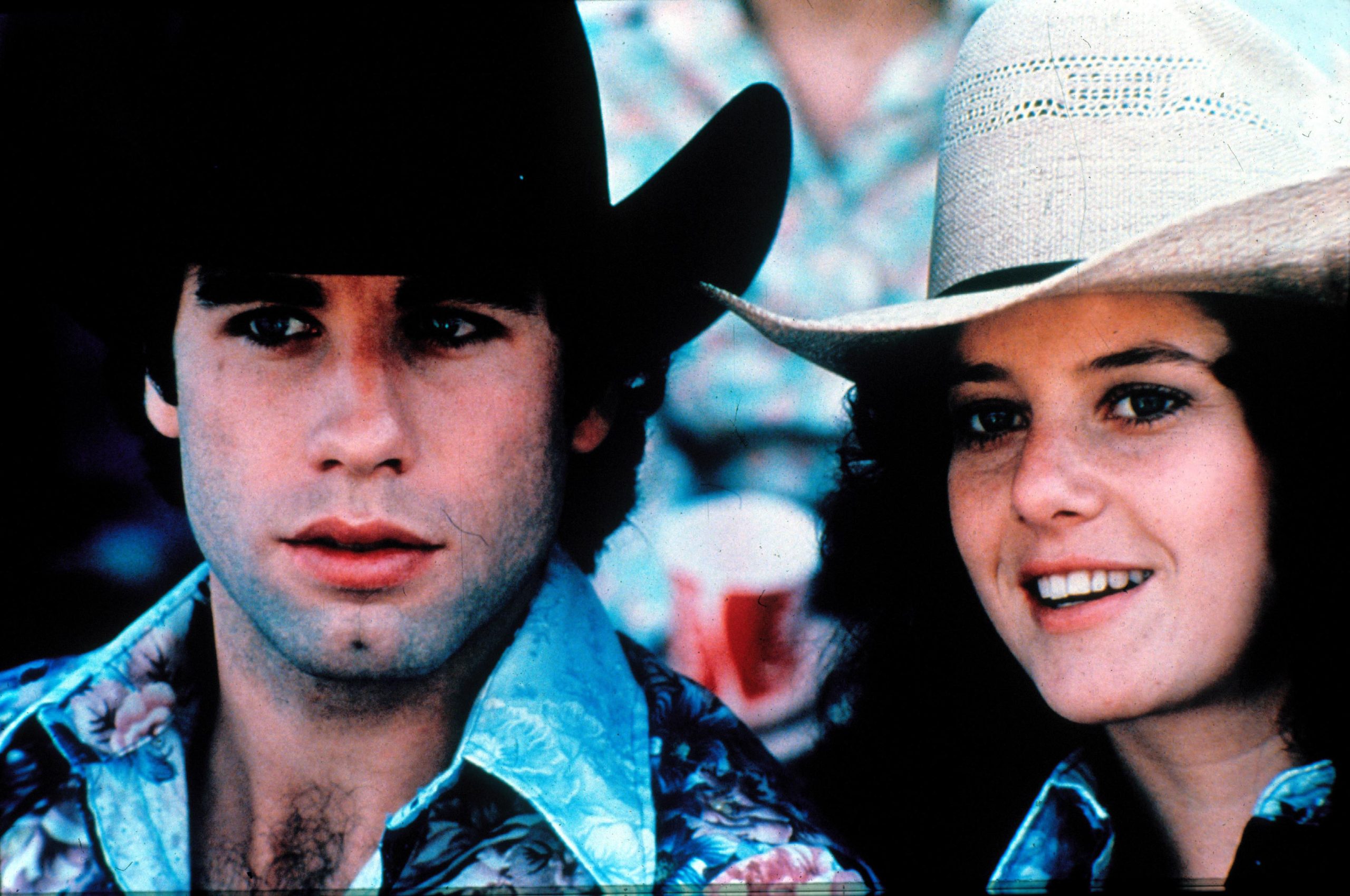
But that sketch doesn’t do Urban Cowboy justice. The film opens as our young hero is packing his bags and getting ready to trade in his downhome life in Spur (pop: 1,690 in 1980) for opportunity in Houston (pop: 1.5 million), more than 450 miles away. As Bud drives his pickup along Memorial Drive, he’s dipping snuff and spitting into a longneck as the Houston skyline towers over him. But Houston isn’t the final destination; it’s the boomtown of Pasadena, where Bud hopes to get a job with his Uncle Bob (played with genuine charm by Lamesa native Barry Corbin in his first film role) at one of the countless oil refineries along the Houston Ship Channel.
In real life, Bud wouldn’t have been alone. At that time, young men from across the state flocked to the refineries for the promise of big paychecks. In June 1980, the month the movie premiered, Texas crude oil was trading at $21.72 a barrel, a 134% increase in just three years. The bust is nowhere in sight.
Refineries are dangerous, demanding environments, and part of the charm of the movie is that it stays focused on the gritty daily life of the working class, avoiding the easy conflict between labor and those fat-cat owners. (Though one of the most telling lines in the film is when Bud steals away with Pam to her posh downtown condo, and she explains her wealth simply: “Daddy does oil.”)
But at its heart, this is a cowboy film, and all cowboy films are, in one way or another, a lament that the day of the cowboy has passed. In Urban Cowboy, the existential question is simple: What does a modern cowboy do when the open range has been replaced with concrete and steel?
For the refinery workers, Gilley’s provides the answer in the form of an artificial, indoor, electric ranch. There may not be horses or a rodeo, but there is a mechanical bull upon which the cowboys (and would-be cowboys) can prove their manhood.
Or womanhood, as the case may be. Part of this film—certainly in its painfully outdated moments— highlights domestic life. It may be one thing for Bud to complain to Sissy that their mobile home hasn’t been cleaned or that dirty dishes are piling up in the sink. It’s another thing entirely when Sissy decides that she wants to ride the mechanical bull—and by all accounts outrides Bud.
In fact, Sissy’s first words to Bud are: “You a real cowboy?” And his answer is, perhaps surprisingly, a bit meta: “It depends on what you think a real cowboy is.” The truth is that “cowboy” takes on many forms, even as the regulars at Gilley’s try to measure up to an outdated standard. Uncle Bud may have been a real-life rodeo champ back in the day, but his career ended when he got stomped in the chute (“I got a plastic bone here in my leg, plastic plate up here in my head, and one plastic nut.”) On a rare date that doesn’t involve going to Gilley’s, Bud and Sissy attend the Texas Prison Rodeo, in Huntsville, where the cowboys are convicts. But that makes them no less brave or admirable; it makes them fearless.
In understated moments of the film, the cowboy myth remains. When Bud arrives at Uncle Bob’s house, a young boy is playing quietly with a cowboy hat and toy revolver in his chair at the dinner table. In another scene, Sissy gathers her things and leaves after Bud returns home after a night out with Pam. As she leaves the trailer, their television is showing a black-and-white western with a gang of cowboys robbing a wagon train.
In the movie Giant (you have watched Giant, haven’t you?), Bick appears embarrassed when his East Coast friends ask about the size of Reata, and after some nifty hemming and hawing, it’s only when he’s pressed that he reluctantly admits that it sprawls across 595,000 acres. In Texas, you’re not supposed to brag about the size of your ranch, but the characters in Urban Cowboy take pride in what they have. When Uncle Bob takes Bud to Gilley’s on his first night in Pasadena, he gushes that the honky-tonk sprawls across “three and a half acres of concrete prairie.” And when Bud surprises Sissy with the purchase of their single-wide, he exclaims, “It’s fifty-foot long, twelve-foot wide. It’s got one bedroom, every modern convenience, and you can move it if you want.”
In the end, audiences were taken by the chemistry between Bud and Sissy, even if the movie glided over serious issues such as domestic abuse in a way that audiences today would never accept. Back then, their rocky relationship was idealized; today, it’s clear to see how toxic their world was. But this is Hollywood, and no surprise, the abusive villain is defeated in a climatic fight (I like Scott Glenn, but I can never unsee him in that black fishnet shirt), and Bud and Sissy reunite as impulsively as they broke up. The triumphant final scene finds them back together in Bud’s truck, complete with license plates restored to the back window that read “Bud” and “Sissy,” driving away from Gilley’s, a moment in which you realize that maybe marriage would be easier if they didn’t go there every single night.
Travolta was one of the hottest actors in Hollywood at the time, having broken out as Vinnie Barbarino in television’s “Welcome Back, Kotter” and then exploding on the big screen in the musical hits Saturday Night Fever and Grease (the former also inspired by a magazine article). Knowing that audiences would fret about an Italian from New Jersey playing a Texas cowboy, Travolta spent a month in Pasadena spending time with the locals, listened to voice tapes to get his accent right, and installed a mechanical bull at his ranch in California to practice.
For Winger’s part, she was a relative unknown with only a handful of acting credits to her name when Urban Cowboy came along. But she was so taken by the role of Sissy that after an initial audition, she went to Pasadena to take a job as a waitress at Gilley’s. Urban Cowboy made her an instant star and earned her two Golden Globe nominations. Her next two roles, An Officer and a Gentleman and Terms of Endearment, the latter based on a Larry McMurtry novel and set partly in Houston’s exclusive River Oaks, earned her Academy Award nominations for Best Actress.
Did Urban Cowboy qualify as the ultimate fad? Gilley’s closed in 1989 after a fire that some say was suspicious. Today, all that remains at 4500 Spencer Highway is an empty lot, where people still stop to take pictures. So too with the Texas Prison Rodeo. It held its last event in 1986, and the stadium was later torn down. Today it’s a parking lot. But the good news is that you can find the original Gilley’s sign just north of Pasadena at Bob N Jeans bar and grill at 4700 FM 1942 in Crosby. Pam’s condo, located at 2016 Main Street, was the first high-rise residential building in downtown Houston, and it remains a desired address for local residents. You can find Uncle Bob’s house in Deer Park on Westside Drive. Of course, you can still drive down the Pasadena Freeway to see the countless refineries, which take on an otherworldly glow at night.
But a fad? We no longer have a monoculture like we did in 1980, but Urban Cowboy’s impact helped make country music one of the most popular music genres in America. And while I’ll confess that it doesn’t happen as often as it used to, from time to time I still see a pickup cruising down the highway with “Bud” and “Sissy” license plates in the back window.